

Introduction
Let’s face it: staring at a gym wall while mindlessly pumping iron on a machine isn’t everyone’s idea of a good time. If you’re tired of the same old clunky weights, expensive monthly contracts, and waiting in line just to use a sweaty bench press, it’s time to try something different. Enter calisthenics—the ancient art of using your own bodyweight to build a chiseled, athletic physique that is as functional as it looks.
Historically speaking, Spartan warriors didn’t have access to fancy cable crossovers or protein-shake bars. They relied on their own mass and gravity to forge legendary strength. Fast forward to today, and bodyweight training is making a massive comeback for a good reason: it works. Whether you want to nail your first clean pull-up or master a mind-bending human flag, having a structured routine is the secret sauce.
Let’s dive into a comprehensive, zero-equipment framework that will transform the way you look at fitness.
Why Bodyweight Training Rules the Modern World
Before we get our hands dirty with the actual routines, we need to talk about why shifting your focus to bodyweight movements is an absolute game-changer.
True Functional Strength
Ever see someone who can bench press an house but struggles to scratch their own back or climb a flight of stairs without gasping for air? That is the classic pitfall of isolated weight training. Calisthenics forces your muscles to work in perfect harmony. When you perform a compound bodyweight movement, you aren’t just hitting one muscle group; you are firing up your core, your stabilizers, and your central nervous system all at once.
Zero Cost, Infinite Freedom
The beautiful thing about a solid calisthenics workout plan is its sheer portability. Your gym is literally wherever you stand. A local park, a hotel room, or even a cramped apartment hallway becomes your personal training ground. No subscription fees, no crowded parking lots, and no excuses.
The Core Pillars of Bodyweight Mastery
To design a routine that actually delivers results without burning you out, we have to look at the fundamental movement patterns. A balanced physique requires hitting every major muscle group through various angles.
       [ Upper Body Push ] ---------> Push-ups, Dips, Handstands
       [ Upper Body Pull ] ---------> Pull-ups, Chin-ups, Inverted Rows
       [ Core Mastery     ] ---------> Planks, Leg Raises, L-Sits
       [ Lower Body Power ] ---------> Squats, Lunges, Pistol Squats
By balancing these four distinct sectors, you prevent muscle imbalances and keep your joints feeling remarkably buttery and pain-free.
Phase 1: The Rookie Blueprint (Beginner Level)
Starting your fitness journey can feel incredibly daunting, but don’t sweat it! The goal here is to establish a solid foundation, wake up those sleeping stabilizer muscles, and get your connective tissues conditioned for heavier loads down the road.
We will use a classic full-body circuit style for this phase. Perform the exercises sequentially, taking a 60-second breather between each movement. Aim to complete the entire circuit three times, running this program three days a week (e.g., Monday, Wednesday, and Friday).
The Beginner Circuit
- Incline Push-ups (10 to 12 Reps): Find a sturdy bench, a kitchen counter, or a wall. Placing your hands elevated reduces the percentage of your bodyweight you have to push, making it perfect for nailing down your form.
- Inverted Bodyweight Rows (8 to 10 Reps): Setting up under a low bar or even a sturdy table, pull your chest up while keeping your body straight as an arrow. This builds the initial pulling power needed for pull-ups later on.
- Air Squats (15 Reps): Keeping your chest proud and dropping your hips back like you’re sitting in an invisible chair. Make sure your knees don’t cave inward!
- Knee Planks (Hold for 30 to 45 seconds): Squeezing your glutes and drawing your belly button toward your spine. If it feels too easy, pop up onto your toes.
Pro Tip: Never sacrifice form for extra repetitions. A single, flawlessly executed rep beats ten sloppy ones every single day of the week.
Phase 2: Forging the Athlete (Intermediate Calisthenics Workout Plan)
Alright, so you’ve built some decent baseline strength and the beginner circuit feels like a walk in the park. Wow, look at you go! Now it’s time to ramp up the intensity and introduce a split-style calisthenics workout plan to spark serious muscle growth.
We are moving to a Upper/Lower split, training four days a week. This gives your muscles plenty of time to recover while drastically increasing the overall volume.
Upper Body Day (Monday & Thursday)
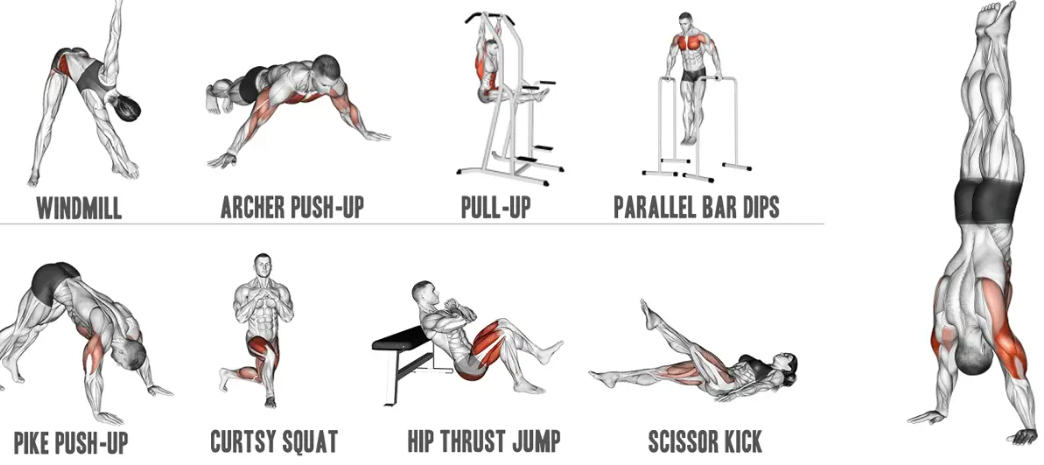
- Standard Pull-ups: 3 sets of 5 to 8 reps. (If you still struggle, use a resistance band for assistance).
- Parallel Bar Dips: 3 sets of 8 to 10 reps. An incredible builder for the lower chest and triceps.
- Diamond Push-ups: 3 sets of 12 reps. Placing your hands close together shifts the emphasis straight onto your arms.
- Australian Rows (Flat): 3 sets of 10 reps to build thickness in the upper back.
Lower Body & Core Day (Tuesday & Friday)
- Bulgarian Split Squats: 3 sets of 10 reps per leg. Elevating your back foot on a chair isolates the quad beautifully.
- Walking Lunges: 3 sets of 20 total steps. Great for building explosive power and balance.
- Hanging Knee Raises: 3 sets of 10 to 12 reps. Hanging from a bar, pull your knees up to your chest using your lower abs, not momentum.
- Calf Raises: 3 sets of 20 reps. Stand on an elevated ledge to get a full, deep stretch at the bottom.
Phase 3: The Gravity Defier (Advanced Level)
This is where things get seriously wild. If you want to unlock elite skills like the muscle-up, front lever, or handstand push-ups, your training needs to become highly specific.
Instead of just chasing high reps, advanced bodyweight training focuses on altering leverage to make movements exponentially harder calisthenics workout plan.
Sample Advanced Routine Structure
- The Muscle-Up Transition: 4 sets of 3 to 5 reps. This explosive movement requires pulling yourself high enough to transition into a dip at the top of the bar.
- Pike or Handstand Push-ups: 3 sets of 6 to 8 reps. Elevating your hips or leaning against a wall shifts your entire weight onto your shoulders.
- Archer Pull-ups: 3 sets of 5 reps per side. Pulling up to one hand while extending the opposite arm straight out simulates single-arm pulling strength.
- Pistol Squats (Assisted or Free): 3 sets of 5 reps per leg. A full, single-leg deep squat that demands immense balance, mobility, and raw quad power.
Tracking Progress Without the Iron
One of the biggest complaints critics have about bodyweight training is that it’s tough to measure progress. With a traditional barbell, you just slap on another 5-pound plate. Simple, right? But with a bodyweight setup, you have to get a little more creative.
To keep progressing, focus on these variables:
- Altering Leverages: Moving from regular push-ups to decline push-ups shifts more weight to your upper body.
- Slowing Down Time Under Tension: Try taking 4 seconds to lower yourself down during a pull-up. Trust me, it burns like crazy.
- Decreasing Rest Times: Shaving 15 seconds off your rest periods keeps your heart rate spiked and boosts endurance.
Nutritional Fueling for Peak Bodyweight Performance
You can follow the most masterfully designed training program on the planet, but if your diet is a total trainwreck, your results will be too. Calisthenics relies heavily on your strength-to-weight ratio. Carrying excess body fat makes every single movement significantly harder.
Focus on consuming whole, single-ingredient foods. Prioritize lean proteins like chicken breast, fish, tofu, and eggs to rebuild torn muscle fibers. Don’t skip out on complex carbohydrates like sweet potatoes and oats either—they provide the clean glycogen energy needed to smash through tough workouts. And remember, staying hydrated keeps your joints lubricated and prevents painful cramping midway through your sets.
Summary of the Weekly Schedule
To keep your eyes on the prize, here is a quick visual breakdown of how to structure an intermediate week:
| Day | Workout Type | Focus Areas | Approximate Time |
| Monday | Upper Body | Chest, Back, Shoulders, Arms | 45 Mins |
| Tuesday | Lower Body & Core | Quads, Hamstrings, Glutes, Abs | 40 Mins |
| Wednesday | Active Recovery | Mobility work, walking, light stretching | 20 Mins |
| Thursday | Upper Body | Hypertrophy and power volume | 45 Mins |
| Friday | Lower Body & Core | Balance, endurance, deep core stability | 40 Mins |
| Saturday/Sunday | Rest | Complete relaxation and muscle rebuilding | – |
Conclusion
At the end of the day, transforming your body doesn’t require a room full of expensive, heavy machinery. Your own body is the ultimate tool for building an aesthetic, powerful, and highly capable physique. By applying consistent progression to this structured calisthenics workout plan, you will smash plateaus, build real functional strength, and unlock movements you never thought possible.
Stop waiting for the “perfect” moment to start. Find a pull-up bar, clear out some space on your living room floor, and start mastering your own gravity today!
Frequently Asked Questions
Can I build massive muscle using only calisthenics?
You bet! While bodyweight training is incredible for creating a lean, ripped athletic look, you can absolutely pack on serious size. The trick is continuously forcing your muscles close to failure by utilizing harder exercises, adjusting your body angles, and controlling the tempo of your movements.
How many times a week should I train?
For most people, training 3 to 4 days a week strikes the perfect balance. Your muscles don’t actually grow while you’re working out; they grow when you are resting and sleeping. Giving your body adequate downtime prevents nagging injuries and keeps you fresh.
Do I need to buy any special equipment to start?
Not at all. While a cheap doorway pull-up bar or a set of gymnastic rings will drastically expand the types of pulling exercises you can do, you can completely start with nothing but a floor, a wall, and a sturdy chair. Get creative with what you have around the house!

