

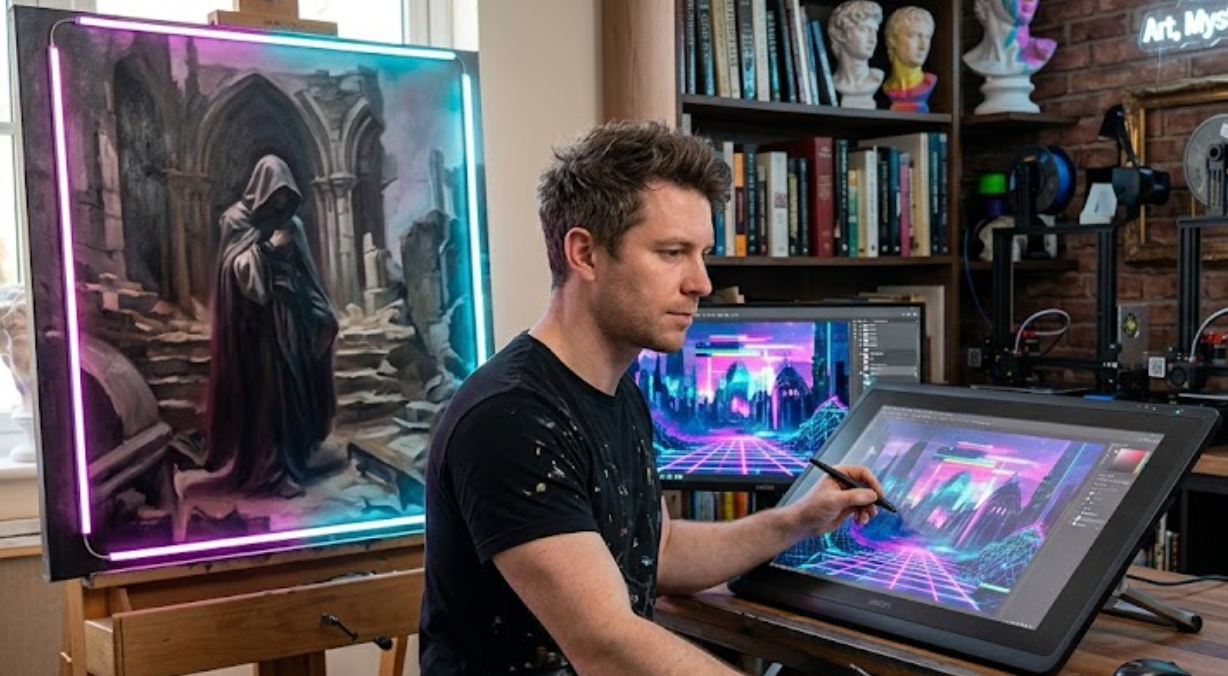
Art has always been a bit of a wild ride, hasn’t it? Just when you think every boundary has been pushed, every canvas stretched to its limit, someone comes along and completely shatters the mold. Enter Gabriel Sanderson Woodall—a name that’s rapidly becoming synonymous with a strange, beautiful, and utterly intoxicating blend of the old world and the deeply futuristic.
If you haven’t stumbled across his work yet, honestly, where have you been hiding? Tucked away in the digital underground before exploding into high-end galleries, his creations don’t just ask for your attention; they demand it. He is a creator who feels less like a modern painter and more like a cosmic cartographer, mapping out the spaces between our wildest dreams and our deepest anxieties. Let’s dive straight into the rabbit hole and figure out what makes this visionary tick.
Introduction: Who is Gabriel Sanderson Woodall?
To understand the art, you’ve got to at least try to understand the man behind the curtain. Born into a family of classical historians and experimental musicians, Gabriel Sanderson Woodall grew up in an environment where boundaries between disciplines simply didn’t exist. Dinner table conversations morphed from 14th-century Italian frescoes to the physics of modular synthesizers without skipping a beat.
Wow, talk about a chaotic yet brilliant upbringing!
It’s no surprise, then, that his adult work defies easy categorization. Is he a digital illustrator? A classical oil painter who happens to use pixels? A philosopher with a stylus? Heck, he’s probably a bit of all three. Walking through an exhibition of his feels less like looking at frames on a wall and more like stepping into a living, breathing ecosystem of myth and machinery. Standing before his massive multi-media installations, the sheer scale of his ambition becomes immediately obvious.
The Genesis of a Unique Aesthetic
Every artist has that “eureka” moment, that lightning-bolt realization where everything just clicks. For Woodall, it happened during a rain-drenched summer trek through the ruins of Western Europe. Surrounded by crumbling Gothic architecture while listening to glitch-hop music on a dying smartphone, the conceptual contrast hit him like a freight train. Why not bridge these two worlds?
Blending the Ancient and the Digital
Most folks think of history and technology as opposing forces. One looks backward; the other sprints forward. But Gabriel Sanderson Woodall saw them as two sides of the exact same coin. By layering classical, Renaissance-era composition techniques with hyper-saturated, glitch-art digital texturing, he created a visual language that feels both incredibly ancient and dizzyingly fresh.
The Signature “Neon-Chiaroscuro” Style
You’ve probably heard of chiaroscuro—the dramatic use of light and shadow popularized by masters like Caravaggio. Well, Woodall takes that concept and kicks it up a notch. Instead of soft candlelight illuminating a dark room, his shadows are pierced by:
- Piercing neon cyan and magenta lacerations.
- Holographic overlays that seem to shift when you look at them sideways.
- Phosphorescent brushstrokes that mimic the glow of a computer monitor in a pitch-black room.
It’s a gorgeous, moody, and slightly unnerving aesthetic that captures the essence of 21st-century alienation while keeping one foot firmly planted in classical beauty.
Breaking Down the Masterpieces
You can’t fully appreciate the genius of Gabriel Sanderson Woodall without looking at the actual pieces that put him on the map. He doesn’t just pump out art for the sake of it; each piece is a chapter in a massive, ongoing narrative universe.
“The Digital Alchemist” (2024)
This was the piece that truly broke the internet. Depicting a robed figure holding a glowing, floating hypercube, the painting uses actual gold leaf layered over a high-definition LED canvas. It’s a literal fusion of physical craftsmanship and digital programming. The textures are so rich you can practically feel the history bleeding out of the frame—if you were allowed to touch it, of course, which the gallery guards absolutely forbid!
“Echoes of the Silicon Forest” (2025)
A massive triptych that explores the intersection of nature and artificial intelligence. At first glance, it looks like a serene, classical landscape painting of a dense woodland. Look a little closer, though, and you’ll realize the leaves are made of intricate circuit patterns, and the deer drinking from the stream have eyes that glow with the cold light of an active optical sensor. It’s a haunting commentary on where our planet might be heading, delivered with a velvet glove.
The Philosophy Behind the Pixels
Let’s face it, a lot of modern art can feel incredibly pretentious. It’s easy to get lost in a sea of artsy jargon that doesn’t actually mean anything to the average person. But what makes Gabriel Sanderson Woodall so refreshing is his refreshing lack of pretense. He’s incredibly open about what drives his creativity.
“Art shouldn’t be a riddle you need a PhD to solve,” he remarked in a rare interview last year. “It should hit you in the gut first, and make you think second. If you don’t feel a spark of wonder or a chill down your spine within the first three seconds of looking at a piece, I haven’t done my job.”
He’s deeply fascinated by the concept of digital folklore. In an era where we spend more time looking at screens than at the sky, what happen to our old myths? Do gods move from mountaintops into the cloud servers? These are the heavy, existential questions that simmer beneath the surface of his vibrant color palettes.
How Gabriel Sanderson Woodall is Disrupting the Art Market
The traditional art world is notoriously stuffy, fiercely protective of its gatekeepers, and slow to change. So, how did a rogue digital philosopher manage to storm the castle? By completely changing the rules of engagement.
+------------------------------------+------------------------------------+
| Traditional Art Market Approach    | The Woodall Disruption Strategy   |
+------------------------------------+------------------------------------+
| • Exclusive, invite-only galleries | • Open-source digital previews     |
| • High barriers to entry for youth | • Hybrid physical/digital drops    |
| • Static, unchanging exhibitions   | • Interactive, evolving spaces    |
+------------------------------------+------------------------------------+
Instead of relying solely on elite galleries to validate his worth, Woodall took his work straight to the people. He utilized social media not just as a portfolio, but as a living laboratory, sharing unfinished drafts, asking his audience for input on color schemes, and pulling back the curtain on his creative process. By the time the major auction houses came knocking, he already had a fiercely loyal, global community backing him up. Talk about turning the tables!
The Craft: Tools of the Cosmic Trade
People always want to know the secret sauce. What programs does he use? What kind of brushes? While he guards some of his proprietary digital techniques pretty closely, his studio is a wild testament to his multi-disciplinary approach.
On one side of the room, you’ll find traditional easels stacked with premium linen canvases, jars of raw pigment, and bottles of linseed oil. On the other side sits a monstrous, custom-built workstation liquid-cooled to handle heavy 3D rendering engines, VR headsets, and digital drawing tablets.
He doesn’t view technology as a shortcut. For him, mastering a digital sculpting tool requires the exact same discipline, muscle memory, and spatial awareness as mastering a physical chisel. Having spent thousands of hours refining both skills, his ability to seamlessly hop between mediums is nothing short of breathtaking.
Looking Ahead: The Future of Surrealism
So, where does he go from here? Having already conquered the digital and physical gallery spaces, Gabriel Sanderson Woodall is reportedly setting his sights on immersive, room-scale virtual reality installations. Rumor has it he’s collaborating with software engineers to create an entire virtual museum where the architecture itself reacts to the heart rates of the visitors.
It sounds wild, almost impossible, but if anyone can pull off a stunt like that, it’s definitely him. He’s constantly pushing, constantly asking “what if?”, and refusing to rest on his laurels. In a creative landscape that can sometimes feel safe and repetitive, his relentless drive to innovate is a breath of fresh air.
Conclusion: The Lasting Impression
At the end of the day, art is about connection. It’s about finding those rare, beautiful moments that make us pause, take a step back from our chaotic daily routines, and look at the world with a renewed sense of childlike wonder. Gabriel Sanderson Woodall manages to achieve that feat effortlessly, bridging the massive chasm between our historical past and our hyper-technological future.
Whether you’re a seasoned collector with a discerning eye or just someone who appreciates a stunning visual, his work leaves an indelible mark on the psyche. He reminds us that even in a world increasingly dominated by cold algorithms and data streams, the human soul, with all its chaotic imagination, still holds the ultimate brush.
Frequently Asked Questions
Where can I see Gabriel Sanderson Woodall’s art in person? While his digital previews are widely available online, his physical installations regularly tour major contemporary art museums in New York, London, Tokyo, and Paris. Keep an eye on his official studio updates for upcoming exhibition dates!
Does he sell his work as digital assets or physical paintings? He actually does both! He frequently releases hybrid collections where the buyer receives both the original physical canvas and a unique, verified digital twin that includes animated elements not visible on the static painting.
What advice does he give to aspiring young artists? Woodall always champions the idea of hybrid learning. He consistently advises young creators not to abandon traditional drawing and painting skills in favor of digital tools, but rather to master both so they never feel limited by their medium.

